Showing posts with label Other. Show all posts
15+ Clever Guerrilla Marketing Ideas By Store Owners Who Use Their
Heads Instead Of Money

15+ Clever Guerrilla Marketing Ideas By Store Owners Who Use Their Heads Instead Of Money

Marketing can be e-x-p-e-n-s-i-v-e... Luckily, there's always the guerrilla marketing alternative. For those who don't know, it's a marketing strategy that focuses on imagination, original ideas, and low or no expenses at all. So, how does it work? Basically, it takes consumers by surprise, by popping up at unexpected places, making a lasting impression. Dying to see what they look like? Check out this list of the coolest guerrilla advertisements compiled by me.

Have you seen any eye-catching guerrilla advertisements yourselves lately? Add your pics to the list below and don't forget to vote!

Walked Into My Local Grocery Store. Wasn't Dissapointed

Memorial to The Murdered Jews of Europe

One of the most impressive and controversial memorial to the Holocaust is located near Brandenburg Gate, in the Friedrichstadt neighborhood of Berlin. The Memorial to the Murdered Jews of Europe, also known as the Holocaust Memorial, was designed by New York based architect Peter Eisenmann, and consist of a sea of 2,711 charcoal-colored concrete blocks called "stelae" laid out in a grid pattern over a 4.7 acre site of undulating ground. From a distance, the memorial site looks like a graveyard with the concrete steale resembling tombstones. The concrete blocks are not uniform in size and ranges in height from a mere eight inches to over fifteen feet tall. Visitors can enter from all four sides and lose themselves in the labyrinths of narrow paths between the concrete blocks. In the southeast corner of the site, located underground and accessible via two flights of stairs, is an Information Center that holds the names of approximately 3 million Jewish Holocaust victims.

memorial-murdered-jews-europe-berlin-13

Photo credit: Bartek Kuzia/Flickr

Quincy Granite Railway: America’s First Commercial Railroad

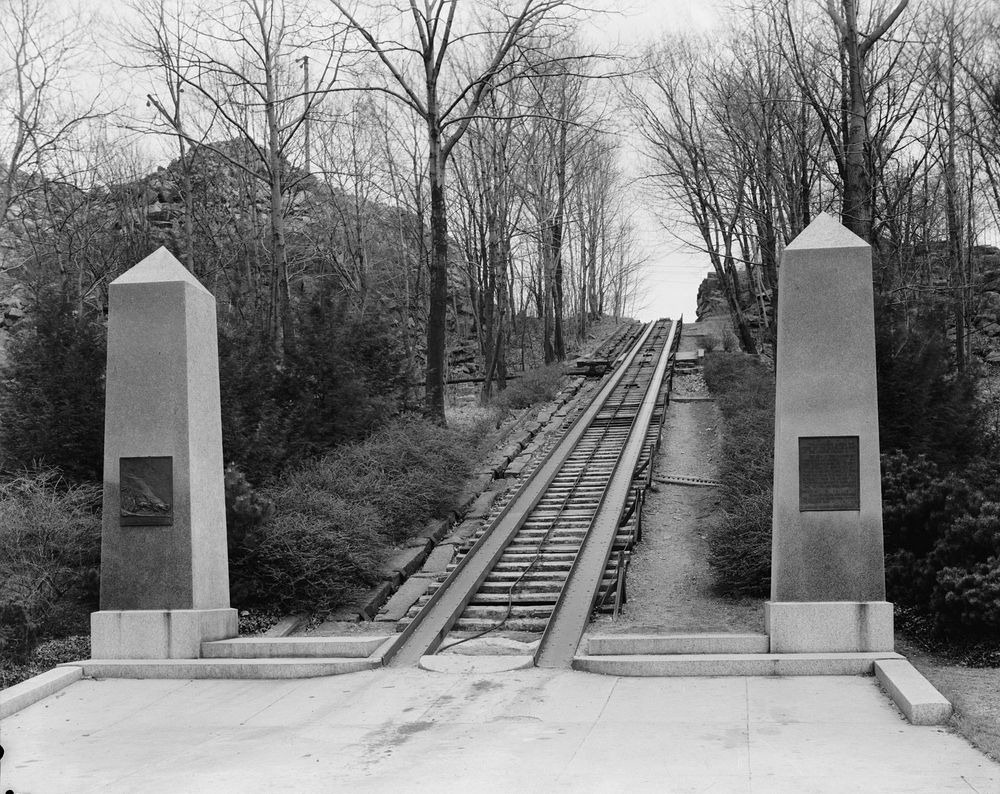
When architect Solomon Willard arrived in Quincy, Massachusetts, in 1825, and discovered a granite ledge in a wooded area, he knew he had found the perfect raw material for what would become his most famous building, and the first monumental obelisk erected in the United States — the Bunker Hill Monument. Willard envisioned a 221-foot tall obelisk with a 30 feet square base that would require some 6,700 tons of granite. Transporting the massive blocks of granite from the quarry to the site of construction presented a challenge.

Quincy was separated from Charlestown, where the monument would be erected, by 12 miles of swamp, forest, and farms. The granite needed to be delivered to Neponset River, four miles north, from where a barge would transport the stone through Boston Harbor to Charlestown. Willard wanted to move the stones to the Neponset River on sledges during winter, but Gridley Bryant, an engineer, suggested a more efficient method — a railroad.

quincy-granite-railway-2

The Incline portion of the Granite Railway, Pine Hill Quarry to Neponset River, Quincy. April 1934. Photo credit: Arthur C. Haskell/Library of Congress
How To Find A Hobby To Last You A Lifetime

How To Find A Hobby To Last You A Lifetime

“what are your hobbies?” question? This happens for several reasons. On one hand, it’s likely that you don’t really know if you have any hobbies to begin with. What exactly classifies as a hobby? Can you say that browsing the Internet all day long and binge-watching House of Cards count as a hobby? And to give some answers before moving on, yes, it does. As long as it’s something that you fill your pastime with because it’s an activity you enjoy, it counts as a hobby.

How To Find A Hobby

The Highway of Death

Twenty five years ago, one of the most brutal massacres in war history occurred in Iraq, along Highway 80, about 32 km west of Kuwait city. On the night of February 26–27, 1991, thousands of Iraqi soldiers and civilians were retreating to Baghdad, after a ceasefire was announced, when President George Bush ordered his forces to slaughter the retreating Iraqi army. Fighter planes of the coalition forces swooped down upon the unarmed convoy and disabled the vehicles in the front, and at the rear, so that they couldn’t escape. Then wave after wave of aircraft pounded the trapped vehicles for hours on end. After the carnage was over, some 2,000 mangled Iraqi vehicles, and charred and dismembered bodies of tens of thousands of Iraqi soldiers lay for miles along what came to be known as the “Highway of Death”. Several hundred more littered along another road, Highway 8, that leads to Basra. The scenes of devastation on these two roads became some of the most recognizable images of the Gulf War.

highway-of-death-iraq-11

Photo credit: www.informationclearinghouse.info